The following text is a fictional dialogue, inspired by the principles of Stoicism and the teachings of Seneca. It is not an exact reproduction of his works.
My entire life was an endless attempt to make the universe function according to my own personal rules. I lived in my own world, searching for a “manual” for the world of people. At the same time, the people around me seemed so strange, with their nonsensical reactions and bizarre behaviors. I felt like an alien observing a species it didn’t understand. Why do they laugh like that? Why do they get angry over such small things?
The truth is, their actions often confirmed my belief that I came from a species that emits strange cries. My desperate search for the “right” guide began. Was it a god? A guru? A philosopher? Or maybe the neighbor with the curly hair? My mother didn’t convince me, as I never truly understood her logic. My father had a tendency towards philosophy, but his ideas were so rigid they sometimes sounded more like an ideology. I never quite understood what meaning he wanted to give to life. As for my brother, I never understood what purpose this person had in my life.
As my logic went in circles, I began to envy those who seemed to have found their own secret logic without having to read any manual. They ate, went for walks, and laughed—without worrying about the problems of time, existence, and meaning. They were just happy, for their own perpetual reasons. But these people usually lived in different houses than ours, the kind with high walls and barred windows.
For example, I never understood why clerics walked around in black robes. It scared me, as if I were seeing death in person on the sidewalk—a living “warning” of what awaits us. I also didn’t understand why the world was full of self-proclaimed sages who, without me asking them, appeared in my life to declare their “absolute” truth. Who had given them the right to be all-knowing and to know better than me what I should do with my life? It was all so strange that I felt the world needed not just a guide, but a whole translator. And it was clear that none of them were suitable for the job.
A Guide Through Modern Methods
After this realization, I began a desperate search for a “guide” among modern methods. First, I visited a psychiatrist. However, all I achieved was to understand that old Freud had such a unique and outdated view of the human soul that I doubted therapy would help me find meaning. It seemed more likely it would just make me delve deeper into why I had a quirk with the color of my socks. Next, I tried techniques like NLP and EMDR. They were very interesting, like a software update for the brain, but they still didn’t solve my fundamental problem: the search for the world’s “logic.”
I then switched to more alternative methods. Meditation was good because it stopped me from having to think about all these questions. Yoga, on the other hand, pushed my logical boundaries. The soft music and whispered instructions were a perfect setup for what felt like a moment of pure absurdity. Our instructor asked us to get on all fours and perform the “Lion’s Breath”—a ritual of sticking out our tongues and roaring. I just froze. My eyes opened, and I saw a room full of adults roaring like animals. In that moment, I knew I couldn’t continue. My problem wasn’t a lack of a “lion within” it was a mind that simply refused to pretend.
The Paradox of Love
I could also talk about the time I fell in love with someone without any logical explanation. I just looked at him and liked him very much. I felt an attraction that until then I had only felt for objects: books, red Prada sandals, handbags, perfumes. That was “love” for me. And while our chemistry worked perfectly in silence, the problems began as soon as he opened his mouth. I wished he had been mute, it would have made things much easier for me.
He looked like the perfect picture of a man: handsome, with good manners. But as soon as he opened his mouth, things started to get weird. With his very first word, and a calm smile, he announced to me that he had the firm conviction that people are inherently flawed from birth, and using this as an excuse, he had absolution for all his choices forever.
And I, trying to justify this belief in a desperate attempt to salvage things, responded that if we take this as a theory, then perhaps the only reason we shake hands is to exchange our flaws with each other.
That’s when I understood. This man wasn’t just avoiding responsibility. He was the ultimate, the final, the inevitable proof that life has no rules. And just as I was trying to process this revelation, he announced to me with disarming honesty: “This relationship, however, can’t evolve emotionally… because I’m not looking for love.”
I, on the other hand, wondered: What exactly is he looking for? Hate? Apathy? Indifference? Or maybe nothing at all? This was something new. We had moved from innocent idiocy to a philosophy of terror. I decided to play along and asked him with the curiosity of a researcher: “Why do you say that?” And with the same clinical coldness he had before, he revealed to me: “Because I’m in a happy open relationship.” That’s when I realized that his “manual” for life was so different from mine that there was no possibility of understanding him.
The Great Discovery
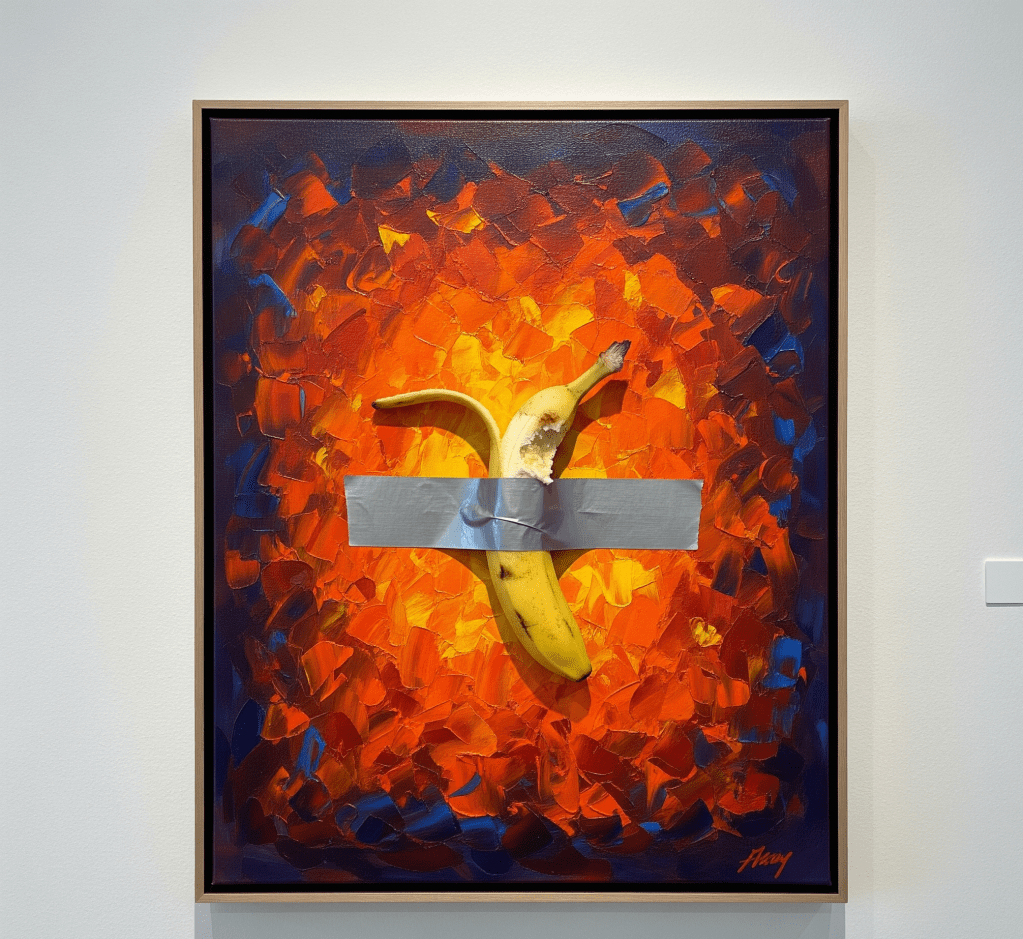
It was a Thursday afternoon, and I was coming home from an art exhibition. My brain was exhausted from trying to find logic in paintings that looked like splatters. For half an hour, I had looked at a row of five bricks on the floor with a serious face, wondering if they had a deep, existential meaning or if they were just waiting for the janitor to use them to repair a wall. I also noticed an object that looked like a half-eaten banana stuck to the wall. While I was sure it was a “clever” reference to Dali, I was just as sure that someone had accidentally left it there. Having exhausted every ounce of my patience and imagination, I decided it was time to go home.
A Fortuitous Reunion
As I turned the corner of my house, I found a book on the sidewalk with a small note, just like the ones I stick everywhere to remind myself of things like “water,” “pay,” “hang up.” My list was much more mundane than what was on the book: “Free to a good home.” It was by Seneca, a great Stoic philosopher, orator, and dramatist of ancient Rome. When I saw it, I immediately remembered that Seneca was one of my imaginary friends at the age of 9, whom I had “created” because I never found common ground with children my age. It was like reuniting with an old friend who, after so many years, might finally give me the “manual” I was looking for.
My Dialogue with Seneca
When I opened the book, my old imaginary friend Seneca came alive. His words, simple, concise, and full of humor, seemed to answer all the illogical questions that plagued me. Our fictional dialogue began something like this:
Me: Why do clerics wear black robes? Seneca: Why shouldn’t they wear black when they have declared war on life? It’s not mourning for the dead, but for the living they chose not to be.
Me: And the self-proclaimed sages who give absolute advice and truths for others’ lives? Seneca: If they had the absolute truth, they would keep it to themselves. True wisdom is found in silence, not in noise.
Me: And the lion in yoga? Seneca: The lion is in the jungle, not in the yoga class. True strength is not roaring like a beast but refusing to roar when the world forces you to.
Me: Why did I fall in love with someone I didn’t match with? Seneca: Why does it rain? Nature doesn’t ask if the clouds match the sun. It just happens. Love is an impulsive storm the decision to stay in it is your own.
Me: But why do all the people in relationships and marriages intrude on singles? Maybe they can’t handle their own choices, and it’s easier to create chaos for others instead of facing it themselves?
Seneca: The coward can’t be alone. Marriage and relationships aren’t a prison, but if you don’t have freedom in your mind, everyone else is your key. They look for their freedom in someone else’s cage.
Me: And the banana on the wall, what was its meaning? Seneca: The meaning is simple: someone was hungry. Wisdom is not seeking a deep meaning in a banana, but accepting that sometimes a banana is just a banana.
New Questions, New Answers
Me: Why do people post photos of their food on social media? Seneca: The hunger for a “like” is more dangerous than the hunger of the belly.
Me: Why do people always have to be so competitive? Seneca: The only victory that matters is the one you win against yourself.
Me: Why do people lie and try to deceive you? Seneca: To seek evil is like drinking poison and expecting the other to die. The person who lies hurts their own soul.
Me: Why do people thirst so much for power? Seneca: Power is a vain illusion. You don’t need to rule over others to rule over yourself. Let others play their games. You play the game of freedom.
Final Realization
…and then the absolute irony dawned on me. I, who had spent my entire life searching for a “manual” for the world of people—from gurus, psychiatrists, and self-help books—had found it on the sidewalk in a book someone else had discarded. My desperate search for the logic of others was in vain, because, as my great Stoic friend reminded me, the secret is to admit that the world has absolutely no logic. And searching for it is like looking for unicorns in the 21st century. In the end, I understood that the truth wasn’t in some manual, but in accepting the absurd. And that my own logic, the logic that comes from the tranquility of my own mind, is the only thing I need to live. Now I can finally stop trying to understand why the neighbor spits in the exact same spot every morning.
 Cognitive Compass