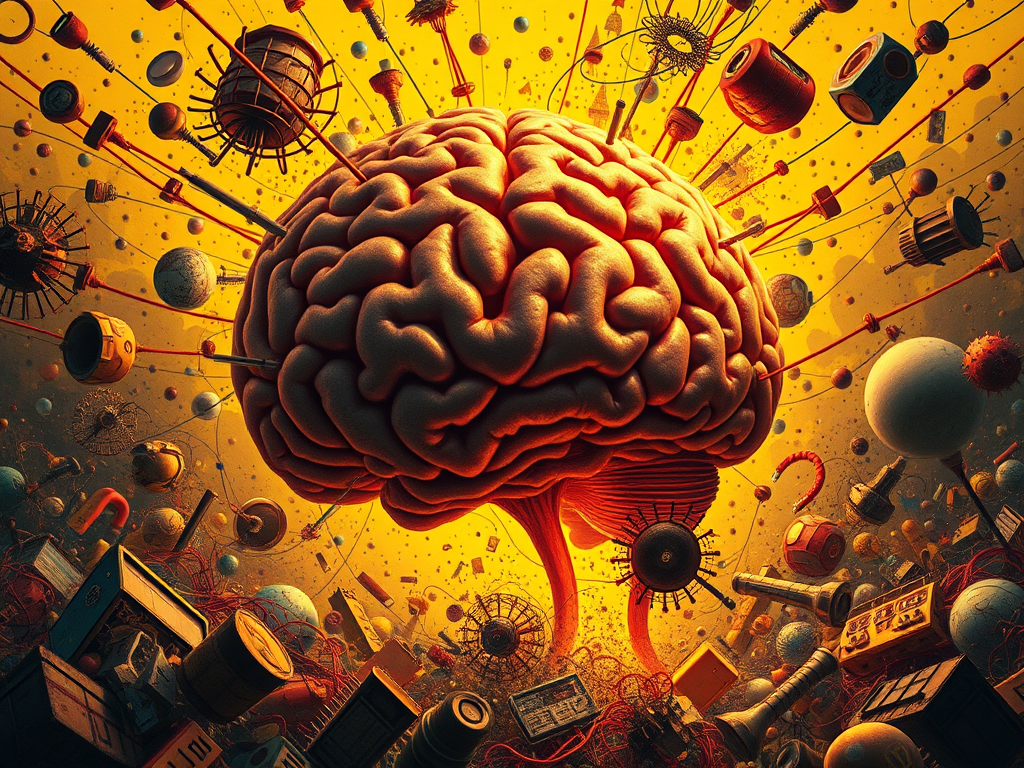
Sensory overload as a living experience
I am standing by the buffet. The sound of forks hitting plates isn’t just noise. It is a metallic storm echoing inside my skull. I notice a drop of red wine on the white tablecloth. To others, it is just a stain. To me, it is a topographical map. It’s a continent of tannins slowly spreading across the cotton fibers.
I retreat to the corner of the living room. The light above my head is an aggressive yellow. It’s that cheap, toxic yellow that blinds you by force instead of illuminating. The bulb has its own electrical frequency. It feels like an electric moan, as if the lamp is trying to tell me its problems.
The physical toll of the crowd
The structure of the sofa catches my attention. The fabric is coarse. I feel this failure of the textile industry scratching my skin even through my clothes. The room smells of alcohol, sweat, and cheap vanilla candles. This olfactory attack blends with the music. The “thump-thump” rhythm has no soul. You don’t hear it with your ears. You feel it in your stomach like a series of small, irregular punches.
I sit in a room full of people. They move with the speed of superficiality. I watch the dust dancing in the yellow light. It’s a mystery how the others can breathe so comfortably in this chaos.
The dance of sketches
I look at the crowd. I don’t see “people having fun.” I see a series of uncoordinated details. Glances “slide” over one another to avoid substance. They seem afraid to touch each other’s reality. These faces look like sketches. They look like actors in toothpaste commercials.
I notice the cracks in their confidence. They nervously adjust their hair. Their laughter stops abruptly the second they think no one is looking. It is a performance everyone agreed to play. However, I never received the script. I am just observing the construction flaws in their roles.
The air pressure changes as the room fills up. The noise of conversations becomes a solid wall. It’s a mass of frequencies that make no sense. Right there, my “safety” in the corner is violated.
The four horsemen of the neurotypical apocalypse
The “four horsemen” of the neurotypical apocalypse appear through the mist of vanilla. Hans, Paola, Klaus, and Jürgen land around my sofa. They have the grace of a wardrobe falling down the stairs.
“Ah, here you are! We were looking for you!” Paola shrieks. Her voice creates a sharp angle against the hum of the lamp. “I’m so glad you came!” she continues with fake enthusiasm. It sounds like a metal chair being dragged across floor tiles. They sit around me like I’m an exotic exhibit in a museum.
Hans throning himself next to me. He makes the fabric of the sofa groan. “Good job, you finally came out of your shell!” he says. The air fills with his heavy cologne. It smells like “desperate confidence” and expired citrus. His shirt is so tight that the third button is fighting for its life. I watch it with awe. I expect it to launch like a bullet at any moment.
Paola crosses her legs. Her heel has a small wear on the side. Klaus stands upright in a “power posing” stance. The cat hair on his lapel has moved three centimeters upward. Jürgen, the know-it-all, sits on the edge of the sofa arm. He holds his glass with his pinky finger raised. He looks like a tiny antenna ready to pierce common sense.
Flipping the script
Hans pokes me on the shoulder. I feel it like an electric shock. “Seriously now, how does it feel to finally be out of your shell?” he asks.
I look at him. Hans expects a “yes, you were right” answer. Instead, I focus on the asymmetry of his face. The pupil of his right eye is slightly smaller than the other. Maybe his brain is trying to save energy on vision.
“Hans, my shell is not a punishment,” I reply with a smile. “It is my personal space of high aesthetics. In there, music makes sense. Out here, I feel like an astronaut who forgot his helmet. Doesn’t this freedom seem a bit… noisy to you?”
Hans is speechless. Before he can regroup, Paola speaks up. “Leave Hans alone, dear. Love is everything!”
“Paola,” I say, “love to me is not a filter that beautifies everything. If the love of my life breathes heavily in my ear, it’s an acoustic attack. My chemistry requires 25 degrees Celsius and absolute silence. Love for me is someone who knows when not to exist. To love you, I must first be able to tolerate you in the same space without you messing up the order i’ve put in my world.
Paola freezes. Klaus, the career counselor, straightens his jacket. “You need to network,” he says with a power-posing vibe. “You give to get. It’s simple math!”
“Klaus, your math is wrong,” I answer steadily. “While you explain how to conquer the world, I wonder how that cat hair on your lapel survived so many handshakes. It’s the only authentic thing on you. Your rules are instructions for a game I have no interest in winning. It’s like trying to convince a fish that happiness is found in owning five different pairs of running shoes for the land.
Klaus looks at his lapel nervously. Then, Jürgen raises his pinky finger like an antenna. “You know, if you focused less on the details and more on the big picture… I’m telling you this as a friend.”
I look at him with sincere curiosity. “Jürgen,” I say, “why do you feel the need to throw your opinion at me? It’s as if you found a piece of trash in your pocket and decided my hand was the appropriate recycling bin. I didn’t ask for it, but thank you for the gesture. Have you noticed that the more advice you give, the more your upper lip sweats? Maybe you should keep these insights for the next self-improvement seminar you attend. You seem to need it more than I do.”
Jürgen is left with his glass suspended. I stand up slowly. The roughness of the sofa releases me, and I feel a sudden lightness. “I’ll leave you to enjoy your dry land,” I tell them with a relaxed nod. “Jürgen, watch that finger, you’ll get a cramp from all that validity.”
I turn my back. I walk through the masks, past the stain-map on the tablecloth, and go out onto the balcony.
Eleven minutes of life vs. a “savior”
I walk out onto the balcony. The air is cold and clean. It has no opinion of me. I light a cigarette. Jürgen follows me out.
“I read a study,” he starts. “Every cigarette cuts eleven minutes off your life. It’s a pity…”
I blow the smoke exactly in his direction. “Jürgen,” I say, “do you know what else cuts minutes off a life? The noise pollution of pointless advice. This last hour cost me three years of neurons. Your arrogance harms anyone within five meters of you. If you want to help my health, try silence.”
Jürgen stands there in silence. “Go inside now,” I say quietly. “The lecture starts soon. I’m afraid my brain will delete you permanently to save itself.”
He leaves. I am finally alone. Dr. V. takes the floor inside. Finally, a frequency worth listening to. I enter the hall and the laptop illuminates the doctor’s face. Hans, Paola, Klaus, and Jürgen are now just blurry pixels in the back rows. I sit in my seat. For the first time tonight, I don’t need to translate anything.
Welcome to autism.
 Cognitive Compass
You don’t have to agree, express yourself freely!